Showing posts with label unschooling. Show all posts

Friday, September 7, 2012

wikis

This past summer I noticed a handful of unpublished posts still sitting on this blog. After going back and forth, I decided not to dither any longer but to either purge or publish. This is the first one I looked at. If memory serves, I was waiting to incorporate some additional material but never got round to it...so now, a full year (!) later, it is just going out as found:

Some time back I started compiling a list of all the interesting wiki pages I ran into, thinking...well, I don't know what I was thinking, really.

My interest was probably piqued because I live in a place which generated one of the earliest city wikis:
Davis, California
There are several more city wikis—and of course, where better to find a list than good old Wikipedia:
largest city wikis
A lot of wikis are hosted on Wikia: Harry Potter, The Office, Lord of the Rings, camerascoffee, vintage sewing patterns, to name just a few. Pick a popular movie, a game, or a tv show, and see if you can't find it here.

Homeschooling? Try Wikijunior or Wikiversity.

Interested in the world and its people? There's Wikitravel, Nativewiki, and one whose name made me laugh when I first stumbled across it: Sikhiwiki.

Like anyone reading this, I suppose, we use the computer for a lot of instant research. And let me add that I'm aware there is controversy over the dependability of the web in general, and wikis in particular, as reliable information content. But with appropriate caution in place, we've had fun wandering the stacks of these wikis when a particular question arose relating to:
Audio Recording
Chickens
iPhones
James Bond
Knitting
Minecraft
Second Life
Tea
I have even started two wikis in the past: a general wiki for our local homeschooling group, and a specific class wiki when some of our kids were learning about countries of the world together. Wikis are a great community learning tool, given that their very nature is based upon community input; but they are dependent upon people being willing to learn to use the site and taking time to share their knowledge, whatever it may be. Here are a few sites that let you create your own wiki:
Google Sites
PBworks
Wetpaint
Wikidot
Wikisite
Wikispaces
Zohowiki
If you have a hosted site already, you can also use software to create a wiki:
DokuWiki
MediaWiki
MoinMoin
PMWiki
TikiWiki
My favorite wikis, however, are not information wikis but project wikis. What's better than to see cool things that people have made themselves?
Instructables
Make Projects
How about you? What are your favorite wikis?

Wednesday, January 18, 2012

the blukuleles—or how to form a group to learn anything

When one is prone to impulsive, hare-brained ideas like buying a blue ukulele with a dolphin jumping across it simply because it is adorable—
—is it a good or bad thing to have friends who are equally loony enthusiastic?
One way to learn something—anything—is to form a group for it. We were all once active homeschooling moms, so it only took a bit of idle talk and a few phone calls to get this thing going. There were no meetings, no person in charge, just a mutually understood agreement that we were going to learn together in a way we knew worked well. Here is how our little learning collective is set up:

  1. We have a name so that everything related to this experience can be easily tagged and recognized.
  2. We share resources with each other, in person and via a shared Dropbox folder.
  3. We have two experienced musicians who can lead us through the process. This was just luck, but I certainly recommend having expert guidance whenever possible.
  4. Early on we set the rule of no self-deprecation. Women, especially, can be prone to saying things like, "You sound so good. I sound terrible..." Not with us. Such statements get quashed immediately by everyone else in the room.
  5. We have fun—admittedly, a given with the ukulele—but are also serious. Meeting times are held to. There is no off-topic chatter. We move fast and try to have a plan for each meeting.
  6. We set goals, ranging from learning a particular song, to playing onstage in one's existing band, to joining other area playalong groups.
  7. And we check in and track our progress: chords learned, songs memorized, patterns recognized, skills built. In this way we can see the concrete results from each practice session.
Group learning isn't for everyone or everything, but it can work very well in the right situation. Years ago, I used this same idea in setting up a knitting class—a class which has since turned into an ongoing knitting group for the last 13 years. And it's the concept behind Young Makers and most every homeschooling cooperative activity. When you're committed to a group, you're less likely to make excuses about practice time and more likely to just find a way to make it happen. If you do fall behind, you are motivated to catch up so as not to slow others down.


Most importantly, a group has multiple eyes, ears and hands. As each person shares a new song, a fingering tip or a video they've discovered, we amplify the learning process for everyone.


It's a cliché, but energy truly is infectious. A good group will encourage progress, cheer each step, and solidify your identity as an ukulele player (or whatever you choose). With our little blue ukes, we are on our way—


Sunday, October 23, 2011

piano lessons

Last night was our monthly potluck with families we have become close to through homeschooling. Many of these kids are now in school, but we all still enjoy each other's company and so gather regularly for communal meals.

As dinner was ending, with parents talking around the table and kids playing in another room, one of the moms very quietly noticed: "...he's memorized it…" Her son was playing a piece on the piano, fluidly and with great musicality.

She then told us that at one point she had called the piano teacher to say her son no longer wanted to continue with lessons as he felt burdened by the need to practice and memorize pieces.

The teacher had responded by saying, in effect, that he didn't need to do these things—it was enough that he come to lessons each week. She then asked to be able to talk with the child directly, so that they could come to "an agreement."

After the next lesson, the son returned and said that he and his teacher now had an agreement: he was no longer obliged to practice, and he would no longer need to memorize pieces. He had already opted out of recitals, because he didn't like to perform. His only part in the agreement was to go to the lesson each week.

And that is when things turned around. Piano became fun, and once it was fun, he found himself wanting to practice. At the dinner, the mom realized he had somehow memorized the piece he had been practicing.

He was also playing before a small audience of friends: performing.

Friday, October 21, 2011

monterey bay aquarium

The reason we go to Monterey each year is for Homeschool Day. The aquarium generously sets aside several Mondays each fall to allow homeschooling families free entry. This is a huge, huge gift and we have used it for nine years now.

This year our time was shortened by C's evening midterm, which meant we could only stop by our favorite exhibits before starting the drive home.
sardines in Open Sea
rockfish in the Kelp Forest
purple-striped jellyfish
moon jellies
sea turtle
white-spotted rose anemone in Rocky Shore
The aquarium is built over the site of the old Hovden sardine cannery and retains a few boilers, along with an exhibit explaining Doc Ricketts' contribution to the fields of marine biology and tidal ecology.
Just outside of the aquarium is Cannery Row, made famous in Steinbeck's novel of the same name. If you look up, you'll see that the trinket shop is actually the original model for Lee Chong's general store.
Science, history and literature: I love how the Monterey Bay Aquarium integrates it all. This was likely our last year to attend Homeschool Aquarium Day, but we still plan to come and visit whenever we can.

P.S. My friend Jen and her family have been longtime traveling companions to Monterey, and she also went down again this year. Please read her take on the aquarium sea horses at her blog post here.

Tuesday, September 27, 2011

dress to apron, part 2

One of the best things about homeschooling one's children is rediscovering how exhilarating learning can be. And when the prime homeschooling years are over, it's hard for a parent to shake the habit of going after that little joy fix—at least, that seems to be a trend among my friends whose children are grown. They begin to take classes in writing and mosaic, in nutrition and environmental studies; they travel, join wine clubs, start new businesses and take up serious cycling.

My own learning ambitions are more modest: in August, I enrolled in Alisa Burke's online class in fabric design, Beneath the Surface. It was a bit of an impulse move for me after a summer of poor health and stalled movement, but I can't recommend it enough. The class was inspiring, accessible to a non-artist, and truly a lot of fun.

It also coincided nicely with the apron project, which I'd always intended to color. I had painted fabric with the kids before, but this class introduced new techniques and more importantly, new ways of combining techniques for a more complex and colorful look.

There was some glue resist and painting with Setacolor:
Regular fabric paint spattered on with a brush tip:
Some stamping:
Some inking. I'm not entirely happy with the final look, but I can think of it as something new I'm learning—and that does make me happy.

Alisa's upcoming class is called Free Motion Graffiti. It looks to be every bit as unique and enjoyable as Beneath the Surface and yes, I'll be taking it. I can't wait.

Sunday, September 25, 2011

brothers

The boys are 5-1/2 years apart in age, and they haven't always been close. There were a couple of years, in fact, where arguments were a daily occurance.

But as with so many things related to children, it pays to wait.  Now 12 and 18, they interact constantly; and I love seeing how their interactions feed each other.
For example, S found the above book one afternoon and began browsing. At first, he was disappointed. "Why is it called Backyard Ballistics if nothing in here explodes?"

C explained the difference between ballistics and explosives. Overnight, it seems, C has become both mentor and teacher to S. He shares with his brother vocabulary, music and computer knowledge, and his interests in politics and history. S has so far not had C's inclination toward devouring news and non-fiction reading, so this is a natural way for him to be exposed to what he might not otherwise take in.

What S leans toward naturally is making things. When he decided he wanted to make one of the projects in the book, I asked him to give me an estimate of what it would cost. This isn't contrived mathematics on my part—he wanted to have it funded. So with his brother's help, he made a materials list, along with estimated costs; I gave the boys a little money, and together they went shopping.

I'm not entirely certain that this project wasn't chosen due to its requirement of empty Pringles cans.
Once the potato chips were eaten, C lost interest; S assembled the unit with help from DH.
You can barely see it, but the photo below shows the tennis ball popping out of the mortar. First try, and it worked! S was thrilled.
He shot the ball out over and over all afternoon, and C came back out and admired his work. These immeasurable moments are why a lot of us homeschool. Trajectory angles come and go, but family is something we hope will always be there.

Right now we still have very much an older and a younger brother, but their age gap will narrow soon enough. If they are lucky, this relationship they are building will give them a place from which to teach, learn from, and encourage each other over the years. That would be enough for me.


Wednesday, August 3, 2011

where we've been (ashland, for one)

This blog has been idle for most of the summer and while there are all sorts of reasons for this, the main one has been pneumonia. It has sapped me of energy, both physical and mental; and though I'm definitely recovering, it's been hard to get back on track. The summer plans I had for cleaning out the garage, tidying up the yard, and putting up a bike shed are postponed for now; it's enough to get through the ordinary day of feeding and watering, cleaning, laundry and errands. And don't get me wrong—I'm grateful to be able to do that much.

Another thing I was glad to be able to do was take the kids back to Ashland for the Oregon Shakespeare Festival. I considered not going, but C offered to help drive if necessary, and I knew I had the option of sending the boys to a play by themselves if I needed to rest.

And everything turned out just fine. We rested plenty, but also walked down each evening to the Elizabethan Stage for 3 different plays. Here is the set for Loves Labour's Lost, as stitched together on my aging iPhone:
There is nothing like sitting outdoors with 1000 other people on a balmy Ashland evening, all cheering together as the flag signaling the start of the play is raised, and then becoming so immersed in the show that there's no memory of when the sun sets and the stars rise overhead.

It was only our second year in Ashland, but we already found ourselves returning to some favorite places. There was Lithia Park, which starts just behind the Festival square and has miles of wooded hiking trail.
Bloomsbury Books, an independent bookseller on Main Street, with a thoughtful selection of titles that we can't pass by.
And our favorite eatery, Dragonfly, which calls itself Latin-Asian fusion food. C made a special request for lunch in the garden here on our last day.
Oops, I have no idea how this picture got in here! Dagoba...? Is that some sort of Star Wars place?
Okay, okay, yes, we went here! Twice, if you must know. (And if you go in summer, remember to take a cooler to pack everything in for the drive home. Not that we filled a cooler, of course—just offering a friendly tip, ahem.)

Where have you been this summer? Does your family have a favorite destination with places you look forward to returning to, or do you aim for ever-new experiences?


Tuesday, August 2, 2011

interview on The Sattvic Family

Elizabeth at The Sattvic Family contacted me with a request to be part of her Unschooling Moms series (her husband is doing a parallel Unschooling Dads series on their blog, as well).


I met Elizabeth through Twitter, where I have been able to follow their family travels in Asia and their current life in Phuket, Thailand. Though our email interview was short and sweet, I am grateful that it gave me the chance to really explore The Sattvic Family blogsite, an incredible resource for traveling families, holistic and spiritual living and of course, unschooling.


I'm going to link to the home page, which currently has my interview up but will certainly be featuring other unschooling parents, travels, and thoughtful writings in the future. Be sure and take a look:


Friday, June 3, 2011

homeschooling, young makers, and the maker faire

It's been two weeks since Maker Faire so seems a little late now to bother with pictures or a recap. You can find both, in better form than I could produce, all over the web.

But I've been thinking about it just the same. This year the kids exhibited in the Young Makers area and got to see the faire from a very different angle. Their projects can be seen on the Young Makers and Young Makers Yolo blogs, but the projects were only part of the experience. They learned so much from exhibiting: how to display in a way that would be informative and interesting, what to do when a crucial piece was left at home, how to cope with fatigue and innate introversion while visitors stopped by and asked the same questions over and over.

I think we all left with new appreciation for those who put all their time into the Maker Faire weekend organizing, volunteering, demonstrating, and giving talks.

I briefly stepped on stage myself as a parent involved with Young Makers. Tony, the host/moderator, asked how Young Makers could be integrated with homeschooling, and I rattled something off quickly. But it's a perceptive question, and it has stayed with me.

In thinking about it, I realized that the Maker phenomenon and homeschooling don't necessarily go hand-in-hand. Very few of our local homeschooling families have shown an interest in the Maker Faire—or even Education Day, the Maker Faire preview which is geared toward school-aged kids.

And the majority of the Young Makers projects came from schools or independent groups of schooled kids.

But as an unschooler, I clearly remember hearing Tony, Dale and Michelle talk last December about their vision for Young Makers. They spoke of it being youth-driven, interdisciplinary, open-ended, and with an end goal of exhibiting and sharing rather than competing. This resonated deeply with me and with our choice to educate our children outside the school system and away from fixed ideas about what one needs to learn at any given age, from arbitrary categories of learning, from grades and awards and external motivators. I thought about these things often as the projects progressed, stalled, and progressed again. In that sense, I suspect our family has more in common with other Young Maker families than with other homeschooling, and possibly even unschooling, families.

This afternoon S and I were riding our bikes, looking at jays and talking about nothing in particular, when he suddenly said, "I want to remember to ask C to show me how he made his project. I want to make one for my bass, so that when I sit in my room and play in the dark, I can see lights flash around the walls. If it's hard, I'll just work on it slowly since I have all summer."

I couldn't say whether this was a reflection of homeschooling, unschooling, Young Makers or some combination of them all. But it was sweet.

Saturday, April 23, 2011

chicks and eggs

When the chicks start regularly roosting on the top of their cardboard enclosure, they'll probably do well in the barn. We moved their heat lamp, and set down more litter and a bigger waterer. They were curious about the new place, but seemed to like it fine.
We had another reason for moving the chicks. Due to a mishap in the original order, a second group of chicks was being sent. From this batch, we received three Ameraucanas.
Actually, I have a hard time looking at this picture. On the same day we took it, our terrier killed the beautiful chick in front. S was extremely distraught; I felt horribly guilty over my negligence about locking Maggie up. It was a mournful afternoon.

But life is a mixture of the sad, the sweet, the joyous and the fun. Our neighbor dropped off a box of her eggs for us. She keeps bantams, including banty ameraucanas who produce tiny green eggs. I love the mixture of sizes and color. (Yes, freshly collected eggs from hens sharing nests are sometimes dirty, especially when it's wet outside; we wash all our eggs just before cracking.)
One day I sat and made tissue paper eggs, which I had seen on this show passed along by a friend.
The next day C decided to do pysanky eggs, which we had tried when the kids were younger. C does not often ask to do crafts these days, and I was surprised that he even remembered this. When S saw his brother making eggs, he asked to do some of his own. S had no recollection of doing pysanky before.
Pysanky eggs are a fairly long process of alternately drawing with wax and dyeing in successively darker colors (there are special pysanky dyes, but we used regular Easter egg colors from the grocery store), then gradually melting off all the wax with a candle flame. It's very relaxing, even if we are far from expert at the process. I had to laugh when I saw the finished eggs and realized that C, our sports fan, had made one egg into a football.
This is the season that reminds us how life cycles on: from baby chicks to older chicks to hens; from a child decorating eggs to a young man decorating eggs. Being able to share these days with my growing kids has been and still is a blessing, and I am grateful.

Monday, February 14, 2011

freecycle


A donation of tools to the Young Makers group got me thinking about Freecycle and how much I love it. It's a simple concept: keep items out of landfill by passing them directly to other people in your community who can use them. You can offer items or ask for items; more often than not, a match will be made. A friend told me that the very first ad she saw on Freecycle was for 30 bobby pins. 30 bobby pins?! But within a few days there was a second notice stating that the bobby pins had been claimed. You never know.

Long before this blog, I considered starting one called The Freecycle Chronicles after I'd noticed how Freecycle was a catalyst to so many good experiences. I once picked up someone's extra plums, for example, and got into a long discussion on her doorstep about Village Harvest and Senior Gleaners.

Then there was the young woman who asked for canning jars and when I offered some I wasn't using, left me a jar of spiced pear butter as thanks. The same woman later picked up an old table I had refinished and no longer had space for and, at a different time, some wool for a needle felting project she was finishing; she only needed a little bit, and I happened to have the colors she requested. You tend to run into the same people over and over in the Freecycle community, which is kind of fun.

In the photo above, S hangs in a string hammock chair, given away because the cushions had gone missing. I can't imagine that he would love it any more with cushions. He sits in it nearly every day that the weather allows. He reads in it, draws in it, sleeps in it and simply looks out at the yard. 

In the background of the same photo, you can see the trampoline we also got from Freecycle. One thing Freecycle really encourages is being bold about taking things apart and putting them back together. We have assembled two trampolines (the first blew into a fence in a strong wind and crumpled like a piece of paper) without instructions; it usually takes all of us working together to do it, but that's a good time, too, isn't it?
Here's the cat tower we picked up for a friend who wanted one for her newly-adopted kitten. It came scratched up, but we asked on Freecycle for carpet scraps and amazingly, received some in a matching shade of blue. Then S and I learned how to recarpet a cat tower together. All except the lower three platforms were redone.
We have passed the kids' bunkbed to a young couple who had just received custody of their nephews; passed a vintage Singer sewing machine to a Renaissance faire costumer, passed along furniture, books, a secondhand trumpet, even moving boxes. Just as we finished the cat tower, someone else asked for carpet remnants and we were able to give them what we had left.

And we have picked up: the entire sound system for our outdoor movie theater, a replacement measuring cup for the rice cooker, and parts for DH's robot project—among many things, all of them remembered with gratitude.

Spammers do hit Freecycle with regularity, but once you learn to spot the telltale signs (an item too good to be true, usually paired with a generated-looking gmail or yahoo account), you can just ignore them. For homeschoolers, Freecycle can be a source of books, art supplies, building materials and the sort of indefinable inspiration one gets from thinking about, in a brief time period, a box spring, quilt batting scraps, parts to an electric door opener, a grapevine wreath, and a roll of shrink wrap (all of which passed through Freecycle this morning). For diy'ers, it's indispensible for odd parts, tools, yarn, 2X4s, and old cotton t-shirts for rags.

And for everyone, Freecycle is another way to be connected to the people in your community, to help and be helped, strike up a conversation, learn something new, save time and money, and step on a path which might lead anywhere.

My favorite Freecycle find? It's Maggie. She barks too much, is overly territorial, and often gets into things which make her stink. We were her fifth home in 2 years and 4 years later, she is still insecure. But she is also sweet and truly devoted, lying quietly on my lap as I type this. You just can't buy that.
Join Freecycle here.

Saturday, November 20, 2010

something new: cheesemaking

I don't do a lot of recordkeeping for homeschooling. Our calendar is there for past and future reference and after all these years, it's clear to me the kids are always learning. The two lists I keep—when I remember—are books we read (old habit) and new things we do. If the latter is sometimes hard to quantify, it's also fun to look back and see how our experiences have grown over the year.

My knitting mentor Ann had made several cheeses over the year. I had also been messaging with a twitter friend, Katharine, about learning to make mozzarella with a friend of hers…so when I saw a notice for a brie class at our Co-op, I impulsively signed up with 11-year-old S. S is a child who loves cheese so much he once ordered a platter for dessert, causing the surprised waiter to ask, "Shall I bring you a glass of port with that, sir?"

(An aside: about two weeks after the class had taken place, I finally listened to spooled-up phone messages and learned that the Co-op did not actually want children to participate in the class at all, although "he is welcome to sit quietly in the back." This is not what happened…I'm very sorry, Co-op.)

Making brie was surprisingly simple: a mixture of organic whole milk and cream is heated; culture and rennet are added; the curds are cut up to reduce the whey; and the mixture is poured into molds where it drains overnight. Because S and I were working as a team, we got one brie mold and one camembert mold for comparison's sake. We learned in the class that brie and camembert are made with the exact same recipe; the flavor is different simply because of the size of the wheel and the differences in milk and air between the two regions. Our brie is the larger, flatter cheese on the left.
After most of the liquid had drained off in the first 24 hours, we salted the cheeses and placed them in airtight containers on paper towels, flipping the wheels and replacing the paper towel frequently.
It took 10 days for a furry white rind to appear.
Two weeks after that, the rind was complete and we were able to wrap the cheeses and let them age.
Yesterday, after 70 days of aging, we unwrapped the cheese with great anticipation.
They looked quite beautiful to us, and were soft and creamy when cut.
But the flavor was off. The brie in particular was sharp and pungent, unpleasantly tangy rather than rich and smooth. C noted that the camembert was pretty close in taste, but our cheese lover S would not take another bite after his first disappointment with the brie.

According to our class notes, there are at least 12 variables which affect the taste, including how gently we stirred the curd and the consistency of temperature during affinage (aging). I suspect we did not ladle out as much curd as we might have, especially since the flatter brie was so much sharper-tasting than the thicker camembert. And who knows about our affinage variables? 

Oh well. Cheesemaking has been added to our list of new things for the year—a tiny, identifiable grain of learning in a wide and varied world.

Wednesday, October 13, 2010

sugar skulls for dia de los muertos (day of the dead)


A few years ago we were lucky enough to have a native Spanish-speaking university student come to the house to teach the kids language and culture. That year we made sugar skulls for the first time under Lizette's helpful tutoring.


We repeated the project last year with S and some of his friends. Although I took photos, I had no blog at the time so am posting them now in time for Dia de los Muertos, which is celebrated on November 1st and 2nd.


We live in Central California, and our local food co-op sells sugar skull molds every year. They come in a variety of sizes and styles, but it seemed to me that it would be easiest for kids to decorate the larger skulls so that is what we have used.


You can also purchase molds online here. This site is an incredible resource, and most of what I will be posting was learned as a result of their own clear instructions.


Ten lbs of sugar will make 10 large skulls. Plan on a couple of extras, because the skulls can crack and break. Trust me: you'll want to be able to pull out a spare immediately if this should occur!


To the sugar, add 1/2 cup meringue powder (available in the baking section of your grocery or hobby store) and mix thoroughly. Sprinkle 7 tablespoons of water over this, and blend until it has the texture of soft beach sand.
Fill the molds firmly, so there are no air pockets which could cause the skull to collapse later. Tamp it down a little at a time with a butter knife or something similar.
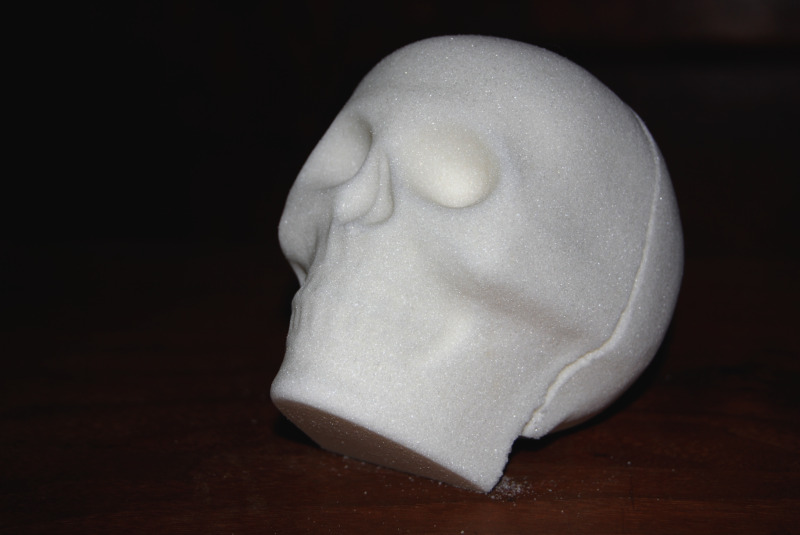
Unmold onto a piece of cardboard. This is where you can first get some problems such as...cracking.
This will have to be put back into the bowl and packed all over again. But better now than later, when it is already too hard to remold.


This large skull mold had two parts: a face and an occiput. Both sides need to dry overnight so they are hard enough to hold in your hands and scoop out the centers. Then you'll turn them over and dry overnight once more.
The two halves are glued together with royal icing: combine 2/3 cup water, 1/2 cup meringue powder and a 2-lb box of powdered (confectioners) sugar in a bowl and beat with an electric mixer until icing becomes glossy and holds a stiff peak when the beaters are raised.


Using an icing bag and tip or a baggie with one corner snipped off, glue the two halves of the skull together. Now your skull looks something like this:
More royal icing, tinted with icing gel, is used to decorate the skulls. The name of the deceased loved one you are commemorating is written across the forehead or on a small piece of colored foil and pasted to the forehead with icing. Although we provided the kids with foil last year, they seemed to prefer the icing (!).
Dia de los Muertos reminds me a lot of Obon, a festival celebrated both in Japan, where my husband and I lived for several years, and in Hawaii, where my mom grew up. It also reminds me of the Hungry Ghost Festival, which we loved seeing in Singapore, birthplace of my father and another place we lived before children.


There is something especially rich about festivals which place us squarely in the continuum of life, reminding us of those who lived and died before and played a part in who we are; and which acknowledge the existence of our dead among us even after their corporeal selves have passed.


That said, it struck me that most of the children last year, even if they had lost a relative in their lifetime, chose to make their skulls tributes to pets. They all turned out beautifully.


Related Posts Plugin for WordPress, Blogger...