Showing posts with label projects. Show all posts

Tuesday, July 8, 2014

a whole new bag

Where does a year go? I have no particular excuse for not blogging since May of last year, just a general impatience with sitting down at the computer these days.

Both boys are now in public school, C at the community college and S at an alternative charter high school. More time is going with the family here, and with friends, here.

The old freecycle fridge was moved and works just fine, save for a tendency for the tiny interior freezer compartment to frost over.
And there are always new projects.

Most recently, I decided to make myself a bag after looking fruitlessly for one that wasn't: a) huge or b) expensive. My old purse had fallen onto decidedly hard times—
—and I wanted something a little brighter for summer, anyway.

The dimensions were determined from the size of my iPad2 (with a little extra room on top, this was approximately 11"X9"), and wallet (about 4" deep).

Since it was cobbled together rather than planned, what I have here are a few notes, many of which come from the experience of making the Weekender bag.

The sides went together first, with pockets (one zippered, one gathered) and straps in place. The main material was a heavy home decor/canvas-y print I'd originally hoped to make the Weekender with, and the straps were from a remnant of aqua-colored vinyl. Every piece was backed with heavy duty fusible interfacing (Pellon 71F). The sides are approximately 14"X12" with 1/2" seam allowances. The finished straps 1"X48", with about an inch eventually disappearing into the seam.
Sides and bottom went on next. It would have been easier to do this as one 4"X29" strip, but I didn't have that option and instead pieced it all together from more vinyl scraps.
Right side out:
Finally, there was a lining (quilting cotton with a lighter interfacing, made to the same dimensions as the outer shell—no photos of this part, unfortunately) and a zippered top. I used this tutorial to make it and if I ever do this again, I hope I remember to leave the zipper open at one end so that the lining can be sewn to the bag by machine instead of by hand.
I'm liking this little tote more than I would have thought. By customizing it, I could put in just what I need and no more. It holds wallet, phone, hairbrush, keys, paper, pen, and hooray, my iPad in a barely noticeable zippered pocket. As simple as it is, it is my favorite feature.
All of which has me wondering what it is that makes a good bag. Do you have a favorite daily carrier and if so, what is it that you like about it?


Saturday, May 11, 2013

old refrigerator (part 2)

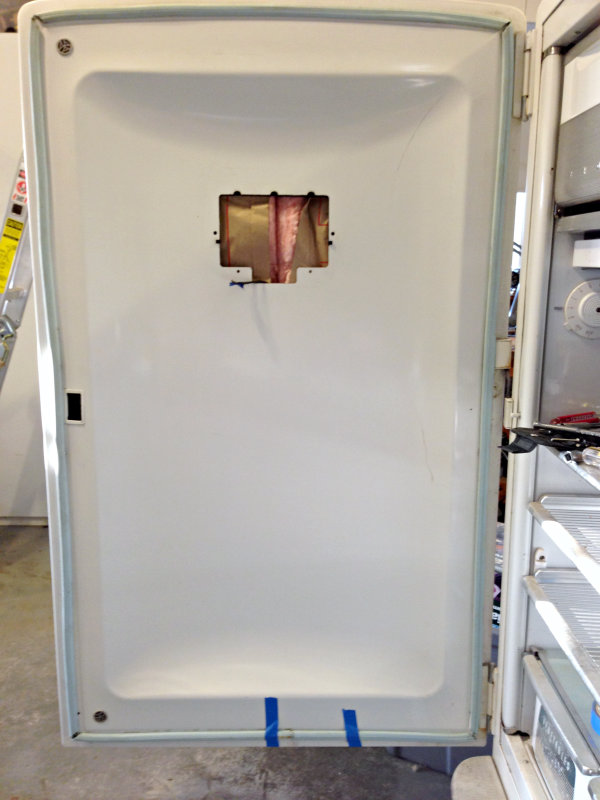
After sanding and repainting, I though I'd just wipe down the gasket. Unfortunately, the dirt was more embedded than I realized, so the gasket had to be removed. This is the point where one thing led to another...

First the interior panel had to come off—


—which revealed the insulation. It looked fine, except for that lower left corner:


Which led me to look more closely at the bottom bracket:

gasket pulled away from bottom bracket, revealing rust and corrosion
bottom bracket removed
What do you do in this case? Do you take out the insulation and repack it? I hadn't figured on getting this deep into an old appliance. While trying to decide what to do, the insulation began to flake off by itself. Finally, I gave up and just removed the cross brackets, letting it all fall out.


Surprise: more rust.


Which meant more (rust-inhibiting) spray paint:


And new insulation. One consolation: the new giant scissors were perfect for cutting the batts.


And the modern paper-backed batts went in easily:


(Note for next time: don't leave the insulation unattended.)


The sanded and repainted bottom bracket:


The gasket was soaked and scrubbed:


And then the whole thing went back together:


In this photo, the butter dish still needs to be reinserted and wired, and blue tape is holding the botom gasket on while the adhesive sets, but it is mostly together. I hope. It still has to be moved, plugged in, and tested. Part 3 of this project may be awhile in coming.


Monday, April 29, 2013

projects simple and not-so-simple

Sometimes projects skate along just as you imagined them, and sometimes—most times, I've come to believe—the project seems to grow in both breadth and depth the farther you get into it.

The Straightforward Project: Old Scissors

Last weekend DH and I decided on a whim to visit a flea market. We never do this, so it was extra fun browsing tables full of old dishes, board games, car parts and aloha shirts. On our way out I spotted this pair of giant scissors and bought them on a whim. They were old and rusty, but they were the largest pair of scissors I had ever seen. I wondered if they might be brought back to working condition. For $2, it seemed worth a shot.

A little steel wool, and some marks began to emerge:
R. Heinisch, Newark, NJ, USA
And on the reverse...
before sanding
"IF IT"S Detmer, IT'S THE BEST"
I think that's what it reads. Not so sure about the last letter of Detme-.

A web search on R. Heinisch mentions production between 1835-1914, when the company was bought by Wiss; and a glance at a 1915 Wiss catalog confirms that the Heinisch name was not retained. These scissors are around 100 years old.

After I had done all I could with the steel wool and chrome polish, I took them to a sewing machine repairman to be sharpened. His charge was only $9, but the scissors turned out to be for paper, not cloth. The difference, apparently, is in the angle of the bevel: dressmaking shears are angled at 30-45 degrees, while paper scissors are angled at 15 degrees. This is why one never cuts fabric with paper scissors and vice versa. Who knew?

In any case, it was a straightforward little project, just a bit of elbow grease and a visit to the repairman. Now what will I do with this humongous pair of office snips (shown here with our regular scissors for comparison)?


The Expanding Project: Old Refrigerator (part 1)

Another Freecycle find. I saw the listing once and ignored it; but when it was relisted, I couldn't resist saving it from the dump. The woman who offered it assured us that surface rust aside, it worked just fine. 
Indeed, the inside was quite clean:

I assumed I could sand down the rust and give it a new coat of paint; and my first efforts seemed to bear this out (color differences are due to photographing before and after photos at different times of day in a poorly lit garage):
the front

the latch

the side
Several coats of paint later, the fridge seemed good to go:
DH replaced the frayed power cord and I figured a good wipedown of the inside would do the trick.

Then I got to the gasket.

To be continued...


Sunday, January 27, 2013

violin case to ukulele case


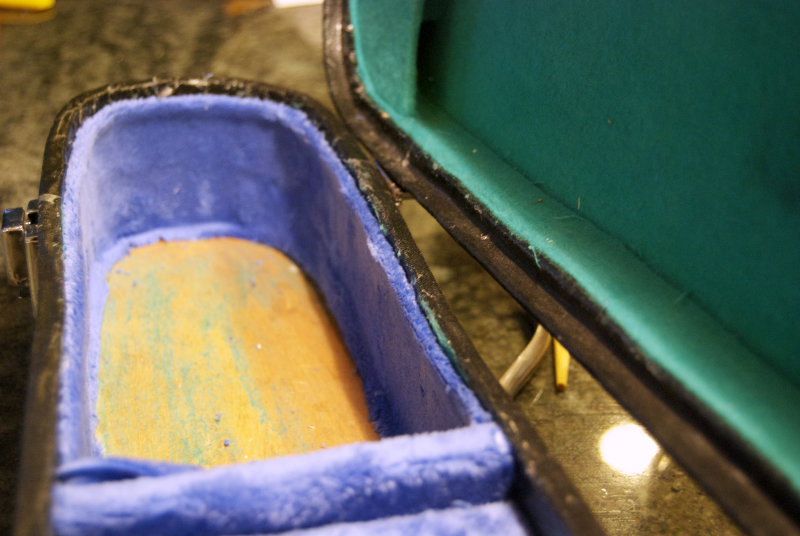
Once the Grizzly was made, it needed a case. My first plan was to try and revise the Gaspar gig bag, but then I lucked into this old violin case on freecycle. It turned out to be a perfect fit for a soprano ukulele.

As with the Grizzly, my documentation is spotty; but it's a fairly straightforward conversion. The old lining comes out and a fitted, padded lining is glued in its place. I used wood glue to attach fabric to plywood, but Super 77 made a smoother, stronger adhesion whenever foam was involved.

Some notes if you make your own version:

  • try to keep the nap of the fabric running the same direction
  • dry fit all the parts before you commit to glue
  • don't be afraid to revise along the way (pictures below show how much revision I ended up making to the neck support before I was happy with it)
  • feel free to substitute your preferred materials or what you have on hand.

materials used
wooden violin case
1/2" velcro strapping
piled fabric (mine was a scrap of Minky), about a yard
1/2" high density foam, about a yard
particle board or thin plywood scraps
wood glue
Super 77 spray adhesive
leather scrap from an old belt
short wood screws
corrugated plastic scraps
decorative paper
Mod Podge

lining removed from bottom half

cross-section: fiberboard, foam, fabric
wood glue brushed inside case
new lining added around edge
the old lining pulled out easily
small compartment under neck; lid is pressure fit
a broken belt used for the compartment strap
belt cut down and attached with short wood screws
the fully padded body area

Above the headstock, a removable container made from coroplast scraps and covered in origami paper 
Another compartment in the lid can store spare strings and papers

If you do make your own case, please consider linking to it in the comments below. I'd love to see other designs and ideas.

In other ukulele news, my ukulele group has grown over the last year, so I started a new blog for us here. If you enjoy uke talk, I hope you'll visit.


Wednesday, January 23, 2013

grizzly ukulele kit (daisy)

instruction manual on top

In December 2011 I had just begun playing uke and was also home with a nasty cough. The two converged together into a rush of web browsing, and eventually I came across this diy ukulele kit, on sale at a price that was far lower than the cheapest starter instrument. Of course I ordered one.

neck, body, miscellaneous pieces

Basic as it was, it sat around for many months before I dared to try and assemble it. I don't know much about wood, and it felt incredibly daunting to turn pieces of wood—even pieces that were precut and partially assembled—into a playable instrument.

step 1: gluing the neck to the body

But I eventually started, and soon after I ran into David Iriguchi of Iriguchi Ukuleles. I confessed with much embarrassment that I was starting a kit. Way back in March at the Reno Ukulele Festival, David's concert keystone uke was the first to make me realize what a truly fine instrument sounded like. So it felt akin to telling a sculptor I was going to make a dog out of Playdoh.

step 2: gluing fretboard to neck

But David was characteristically kind and encouraging. He advised looking up other people's chronicles of their kit builds, and said not to worry too much about precision because it would probably turn out okay.

drying

The instructions directed that the fretboard be put on before staining, but the bridge put on after. If there's logic to this, I don't understand it. I thought afterward that I would have rather put the fretboard on after staining, as it was hard to tape up the bottom curved edges well. 

clamping the bridge to the body with the only tool bought for the project. Cost: $3.

The only modification I made was adding a sound port to give me some direct sound feedback. This is a feature that many of David's ukes have, and I really liked it when I tried them last year.

holes stuffed with wadded newspaper and other surfaces wrapped with painters tape for finishing

What's not documented here is all the sanding and finishing. I had thought it would end with the fine grit sandpaper, but then I read about filling the wood grain and sanding that down, too. Then there was staining, cleaning up the leaked areas, drying, and finally spraying several light coats of lacquer.

ready to add tuners and strings

It was rather tedious toward the end, but worth it for the smooth finish on the body. The stain's not perfectly uneven, but in a way that I can live with. Overall, I'm happy enough with how it turned out.

the daisy uke

The kit is branded with the Grizzly name. I wanted to put a bear sticker on the headstock, but couldn't find anything suitable. What I did find was a sheet of daisy stickers. It was S's idea to put a daisy in the sound hole, as well. Now it feels a little like overkill, so I'll probably remove the stickers eventually. Meanwhile, we've gone from calling it the Grizzly to calling her Daisy.

I can't finish this post without mentioning DH's huge contribution to it. It initially sounded a little thunky to me, so he used a tuner and some filing instruments to bring it to a better intonation. This is not something I would have had either the knowledge, patience or courage to try myself; but I'm very grateful that he did. I sold the Dolphin in October, so this is now the main soprano I reach for.

Every time I play it, I remember how I was afraid to start, and how it turned out okay.

Do you have any projects like that?


Related Posts Plugin for WordPress, Blogger...