Showing posts with label garden. Show all posts

Friday, June 8, 2012

summer project #2: rubber duckie decoy

Fast and simple, my favorite type of project:

Many years ago, a tiny S spied this duck decoy in the back corner of a junk shop and fell in love with it. My dad, doting grandpa, duck lover and insane collector that he was, happily paid $3 to indulge his grandchild and clutter up our house. It soon found its way to our little backyard pond, where it has been floating these past 10+ years.

No beauty when we got it, it was after a decade of weathering in dire need of a makeover. I had yellow spray paint, some white out and a Sharpie; for the investment of a small bottle of orange acrylic, Mr. Faded Decoy Duck became Mr. Shiny Rubber Duckie. And of course he wouldn't be complete without Ernie along for the ride.


Tuesday, June 5, 2012

summer project #1: morning coffee patio

It's been a few years since I've been able to really work hard outside. Clearing out Dad's home, shoulder issues and pneumonia have occupied recent summers. This year the combination of improved health, free time, a freecycle pickup of some old chimney brick and this Sunset project, inspired me to paint our old café set, recover the cushions, and make a shady setting for morning coffee.

Do you have any summer projects in the works? I'd love to hear about them.

Thursday, June 16, 2011

blackberry paletas

It's blackberry season again. And it was hot yesterday, so after tossing some blackberries in a blender and straining out the seeds,
...adding water, lemon juice and agave syrup to taste, we made blackberry paletas.
Because paleta sounds so much more appealing than popsicle, don't you think?

Monday, May 2, 2011

how to make a sun jar

The original Sun Jar was designed by Tobias Wong, but diy versions have been all around the web for years. I'd had a vague interest in making them, so when solar garden lights started becoming smaller and cheaper last fall, I got some and experimented.

Yesterday I saw an ad insert featuring solar lights at The Dollar Tree. You can't get much cheaper than that, so it seems a good time to share this version with you. It's the fastest, easiest and now, cheapest way I know to make a sun jar.

For each jar, you need:
  • a solar garden light (the kind that sits on a stake)
  • a small canning mason jar with a clear lid (Ikea SLOM jars work great)
  • glass frosting spray
  • clear silicone adhesive
The most critical part to keeping this project easy is finding the right solar garden light. Look for those in which the solar unit is a single, compact piece on the top of the fixture. I used these, by Westinghouse:
You can use other types, but it may involve deconstructing the solar unit a bit. This type of light, besides being small and inexpensive, makes it all very easy.
    Make a mask with newspaper and painters tape, and spray the inside of the jar with frosting spray. A few tips: spray outdoors, away from wind, and in a well-ventilated area; shake the can thoroughly before spraying; and keep the can moving slowly and continuously. Finally, use a light touch—the paint doesn't show up well until it dries, so have faith and add a second coat later if you need to.
    Unscrew the solar light unit from the bulb and stake. If you're lucky, it may fit right into the jar lid. If not, use a few blobs of the adhesive to attach it to the top of your jar.
    Run a bead of silicone around the edge of the light unit to secure it—
    —and that's it! You have a solar jar. You may have to remove a protective tab (orange with an arrow in the photo above) to let the battery connect. Close your lid, and place your jar in full sun to charge.
    I made a lot of jars last year, thinking they'd be good Christmas/Solstice gifts, but the winter sun is really too weak to give good charge to the solar cell. They're much better from this point on: the longer, brighter days translate to more glow time in the evening.

    This year I thought I'd add simple hangers. 12 gauge aluminum jewelry wire, wrapped and twisted around the top of the jar, worked perfectly. Each light needed about 30-36" of wire.

    The nice thing about aluminum wire is that it bends and twists easily. The problem with aluminum wires is that it bends and twists easily. In other words, it's easy to work with but also easy to mangle. I prefer to think of it as a deliberately rustic style.
    loop the wire around the jar 
    aluminum wire is soft enough to twist with your fingers
    it can be finished off with pliers
    the finished twist
    pull a loop out from the opposite side...
    ...and twist the loop with pliers 
    thread the end of the handle through the loop you've made
    charging
    With the little handle, you can hang it from a tree—
    —or hang several in a row under your eaves.
    Pretty, aren't they? Like little glass moons suspended in the night. Maybe they should be called Moon Jars instead.

    Monday, April 11, 2011

    spring

    The rains have stopped, and we are again drawn outside. The chicks are more than 3 weeks old already, with nicely developing wing feathers. They're still in the garage, but should be ready to move to the barn in another week or so.
    top to bottom: Silver Laced Wyandotte, Buff Orpington, Barred Plymouth Rock
    There are weeds everywhere.
    We work at them with every method at our disposal, hoeing and pulling, mowing—
    and burning.
    And anyone who wants to help is welcome.
    Happy Spring!

    Tuesday, July 6, 2010

    outdoor movies


    Of all the movies we've watched outside these last three years, the musical Hairspray (above) has probably been my favorite. It has all the elements of a great outdoor movie experience: vivid 60s color, infectious songs, and a sly, sweet sense of humor.

    We are lucky in that despite very hot summers, our local Delta Breezes generally keep the evenings cool. So when we got a projector to show movies in the house, we naturally started thinking about how to project outdoors, as well. The biggest obstacle was in creating an inexpensive, reusable screen. We pondered this problem for years until coming across two sources of inspiration.
    The first was a pair of ancient concrete patio stands from my dad's backyard. I looked at them and realized that they would be perfect support for a frame made of pvc pipe. We had various odd lengths of 1" pvc in the barn so using our available materials and aiming for an aspect ratio of 16:9, the frame was designed to be 14 feet long and 7.5 feet high. Here is what the frame looks like fully assembled:
    It's a little wonky, I know. The securing bolts in the stands were rusted solid, and the pipe rattles around loosely. The two stands are also of slightly differing heights, so a river rock must be dropped inside one of them to bring the screen level. A small slab of concrete is under the center footing, as well. High tech this is not.
    The second serendipitous discovery was of specialized pvc fittings called snap clamps. I chanced upon these online while looking at greenhouse plans--apparently they are meant to secure shade cloth and vinyl to outdoor growing structures. After having struggled with a couple different ways of attaching the screen to the frame, snap clamps turned out to be simple and foolproof.
    The screen is simply blackout shade fabric sewn together to fit around the edges of the frame. One of my early experiments involved lacing through grommets. Though the idea didn't work out by itself, it does help firm up the fabric in conjunction with the snap clamps.
    Additional security is provided by, um, bungee cords.
    We learned through trial and error to prop it against the house. Those same cooling Delta Breezes tended to blow this lightweight screen back and forth like a sail no matter how much additional bracing we used.
    It's homemade, to be sure. But when the projector is turned on it, none of the seams or sags are visible--just a brightly illuminated moving picture. I would love to hear your suggestions for outdoor movies in comments--what would you want to watch on a summer night?

    (P.S. One of these days I plan to add our screen to this very cool site


    Sunday, June 20, 2010

    calendula on father's day

    This is my dad's hoe. He always called it a "chankoh," but I can find no references to such a tool online. He told me it was something they used when he was growing up in Singapore.

    Dad loved to garden, so when he died unexpectedly in the spring of 2008, we gave out seed packets at his service. It was a hard year for all of us, but the kids and I did manage to empty a few packets into some dirt. Sometimes we remembered to water.

    Fortunately, one of the seed packets contained calendula. When the kids were small, I kept calendula spray in the fridge for cuts and scrapes. It is reputed to have antiseptic properties, and it doesn't sting. Calendula, it also turns out, is a determined flower; growing is what-it-does.

    Here is calendula in March:


    And in April:


    Last week the petals had dropped off, so I pulled the plants.


    A close-up of the seed heads:


    And finally, after a few sessions of clipping and sifting...


    ...we can start all over again.Yes, these flowers and seeds are descendants of the original seed packet handed out at Dad's memorial service over two years ago. The calendula plants have lived with us all this time.

    With any luck, we will always have them.


    Tuesday, June 8, 2010

    berries from the yard

    Let's put it this way: no garden society is ever going to ask us to be on their tour. We don't even have a real garden, really; we have a yard. A tumbledown yard with leaning fences, old pallets, piles of broken concrete, weeds, and brambles.
     But at this time of year, the brambles sport olallieberries.
    The center berry always ripens first. I wonder why that is.
    "Quickberry! Quackberry! Pick me a blackberry!"1 When the cap loses its green color, the berry is ripe and will practically drop into your hand.
    And in half an hour, we can fill a colander.
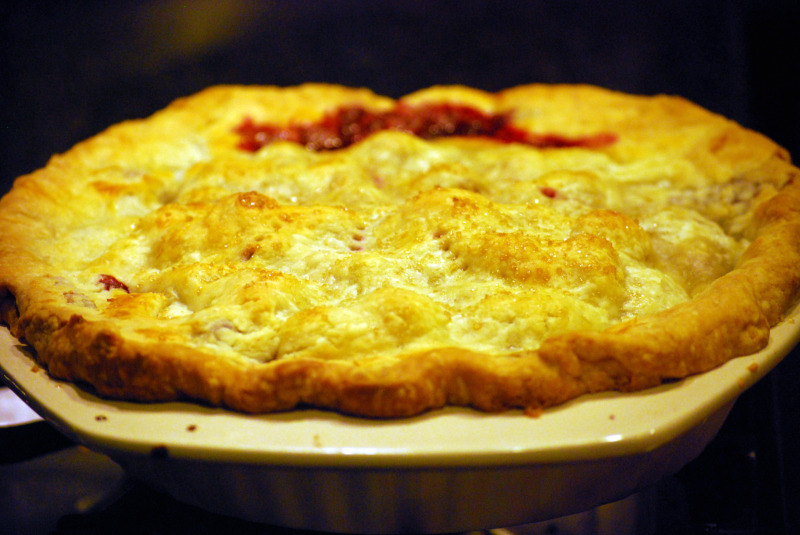
    Pie is just a double crust filled with a mixture of berries, sugar and a little flour to thicken. My older son and I love blackberry pie above all others.
    But my go-to berry dessert is this cobbler shortcake from the back pages of Sunset Magazine, June 2000, and credited to Patricia Yee of Concord, California.
    Below is an exact transcription, but I'll add that it's an incredibly forgiving and flexible recipe. When I don't have buttermilk, I'll substitute plain yogurt. When I don't have lemon zest, I'll use only orange, and vice versa. I've also left out the zest completely and forgotten or reduced the sugar. Since we keep hens and have odd-sized eggs, I often throw in an extra one for good measure. The cake always comes out fine.


    And though it would churn up easily in a food processor, I think what I like best about this recipe is that it goes just as quickly mixed by hand in a couple of bowls. At the end of a long summer day, there is something peaceful and relaxing about making a simple dessert by hand.


    Berry Cobbler Shortcake
    prep and cook time: about 1 hour


    2 cups all-purpose flour
    about 1-1/3 cups sugar
    2 teaspoons baking powder
    1 teaspoon grated lemon peel
    1 teaspoon grated orange peel
    1/2 teaspoon baking soda
    1/2 teaspoon salt
    about 3/4 cup butter, cut into chunks
    2 large eggs
    2/3 cup buttermilk
    2 quarts berries, rinsed and drained (use one kind or mix several), such as blueberries, boysenberries, loganberries, olallieberries, raspberries, or hulled strawberries
    1 cup whipping cream


    1. In a bowl, combine flour, 1 cup sugar, baking powder, lemon peel, orange peel, baking soda and salt. With a pastry blender or your fingers, cut or rub in 3/4 cup butter until coarse crumbs form.
    2. In another bowl, mix eggs and buttermilk to blend. Add to flour mixture; stir with a fork until evenly moistened. Spread batter in a buttered shallow 9-by-13-inch casserole.
    3. Slice strawberries, if using. In a bowl, mix berries with 1/4 cup sugar. Spoon 3 cups berries evenly over batter. If desired, sweeten remaining berries with more sugar to taste.
    4. Bake cobbler in a 350 degree oven until browned, 30 to 40 minutes.
    5. Meanwhile, in a bowl with a mixer on high speed, whip cream until it holds soft peaks; sweeten with about 2 tablespoons sugar to taste.
    6. Cut warm or cool cobbler into 8 portions. With a wide spatula, transfer portions to plates. top equally with remaining berries and whipped cream.


    When I was a kid, my friends and I sometimes picked blackberries roadside. They grow in the most difficult places: down steep creekbanks, over asphalt, around chainlink fences. They grow wild and sprawling without any need for tending. I suppose that's why they grow in our yard.


    I love our yard.


    1from one of our kids' favorite picture books, Jamberry, by Bruce Degen
    Related Posts Plugin for WordPress, Blogger...