Showing posts with label twitter. Show all posts

Sunday, June 24, 2012

sam

Sam & cool kids Simon & Sophie
Two weeks ago, after more than 3 years of tweeting together, Sam and I finally met. Sam wrote about it so well on her blog, but I wanted to note it here too, as it was and will be, I'm sure, the highlight of my year.

Almost from the time Sam and I started exchanging tweets, we joked about being able to teleport into each other's homes for a cup of coffee and conversation. She came across as a warm, likable person, someone who was easy to talk to and fun to be with. More than that, she had that indefinable quality of a likeminded soul, a true friend.

It turns out that she was everything I imagined: effusive, funny, sweet, intelligent. We talked as long-lost friends right away, which felt completely natural, even as I was amazed by it. It was like we had skipped all the preliminaries of getting acquainted, going straight to the easy comfort of hanging out and cooking and laughing together; but in fact, we'd had years of conversation, brief and extended, reading each other's blogs and chatting in groups. We already knew each other.

There are all kinds of friendships: childhood pals, classmates, neighbors, fellow expats/new moms/homeschoolers. With luck, a few of them stick and become part of your lifetime community. I'm glad to now have Sam and Chris as part of mine.
twitter & irl friends Brian, Robyn, Jen, Chris, Sam, me, Lisa (photo by DH)

Saturday, February 11, 2012

bookmarks

Does this look familiar? I bet it does to many of us. I am actually not that much of a reader, but would seem to be better at starting books than finishing them.


Which means that there is a high need for bookmarks in our house.


I love bookmarks almost as much as I love books. When the kids were small, we often made bookmarks specific to the books we were reading. It was a good activity for boys who couldn't sit still while listening, and it was a nice exercise in turning abstract words into something more concrete. I loved seeing their interpretations.


Some bookmarks are manufactured as such and given as gifts:
Some were made as advertising or promotion:
Some are cherished handcrafted items:
I am even known to use random scraps of paper to mark my reading place—do you do this, too?
I could tell you the story of each and every one of the above bookmarks, where they came from, when I got them, what their significance is. I mean it: I really love bookmarks, signifying as they do the optimism of continued learning and the promise that even if you are too tired tonight, you can pick up again tomorrow. Bookmarks save your place, just like a friend.


And bookmarks are on my mind right now because of a question Elizabeth posed on twitter a few months ago: what is an easy way for a non-crafter to begin crafting?


I've thought about this, and I believe the best way is to just make something you can use. At its most basic, crafting is simply the personalization of objects we keep around us. Whether you add a bit of color or whip it up from scratch, the functional property is what separates craft from art, isn't it?


So if you were to make a bookmark, how would you do it? Would you draw and color a strip of cardstock? Glue pieces of newspaper or glossy magazine together and brush with Mod Podge? Would you add a magnet to hold it in place? Fold origami? Stitch up some leftover fabric from a favorite shirt?


Try doing an image search for "handmade bookmark" and see if it doesn't inspire you. If you want to be particularly timely, type in "valentine bookmark." I think a bookmark is the ideal Valentine card—how about you?
English: The photographer's wedding ring and i...Image via Wikipedia

Sunday, January 22, 2012

a pictureless post: on sharing and acknowledgement

An interesting thing happened recently: I checked my email one evening to find that someone had linked to a post about a satsuma candle...a "candle" which looked remarkably like the satsuma lamp I wrote about in December.

Now this has happened before: I'll post a project and then spot a similar one elsewhere. But I've thought of those more in the vein of, "Oh look, someone else had the same idea—what a funny coincidence." It's not like I've been posting the Theory of Relativity, after all.

This particular time was different. The satsuma lamp is an adaptation of a project that's been floating around the web for many years. I've seen it posted and reposted in various guises already, and I know exactly which modifications I added. So when I read phrases about, for example, scoring 1/3 of the way down the skin and drying it out overnight for a better burn, it didn't feel like much of a coincidence to me.

I will add that this blogger made a point of saying she had learned it from a friend at a dinner party; so some kind of argument could be made wherein the friend read my post, forgot where she read it but could still use her otherwise eidetic memory to give detailed instructions to the blogger dinner party guest, who transcribed her instructions verbatim. Whew.

I'll let you do your own math. In any case, it got me thinking.

This is the web, the worldwide web, and we all publish with the intention of sharing our ideas. We expect them to be passed around the way we ourselves pass around findings which inspire or amuse us. But knowing how quickly things can spread, it's important that we also share source and history. This is about connecting, not about competition.

Or is it?

With all this sharing, the web becomes bigger and noisier all the time. Perhaps when one's income is based on blogging, the desire for traffic and recognition trumps the ability to acknowledge that we are all part of the same world and all learn from each other. That's all I can come up with, anyway. Twitter friend Lori, whose homeschooling writings have been plagiarized on multiple occasions, put it more succinctly (we were on twitter, after all): laziness + entitlement. 

I will tell you, and not to my credit, that the satsuma post ate at me for a couple days before I was finally able to rethink it in a way that brought more joy than offense. I looked at my stats and learned that whereas for most of its life this blog has been a little side project of my twitter account, it somehow took a growth leap in December. I have followers and subscribers that I can't trace back to twitter anymore. Posts have been shared and pinned beyond my circle. I don't understand what tipped the balance, but I'm happy about that.

So along with my rant I want to offer a heartfelt thanks to all who are reading and appreciating and sharing—with or without attribution. I do truly love how the web has made our world both smaller and richer in this and so many other ways.

And I plan to take a simple precaution. I'm not at the point where I want to add watermarks or post warnings all over the blog (although I now have much greater sympathy for those who do), but I've decided to double post any new projects over on Instructables before I post them here. Instructables has a large readership and a supportive community, and S and I have used it in the past to publish our joint projects. I've also cross-posted from here to there, or vice versa, from time to time. I'll just make it a point to do so more consistently and hope it will be harder to pull a project from a big site like that without it being noticed.

In keeping with today's theme, I'd like to publicly thank the tweeps who responded, shared their own stories, and otherwise helped me to get to today's post. With gratitude to HSofia, Sam, Jen, Lori, & Cathy.

Tuesday, December 6, 2011

white christmas (with quiz & lyrics)


Cover of

I've mentioned previously that when I was young, the Bing Crosby movie White Christmas was broadcast every December 24th. My older sister and I watched it together every year; so much so that once we had both left home for other countries, one of the pangs I would get around Christmastime was that I couldn't watch this movie with her. No one else in the world can make me laugh simply by saying, "Mutual, I'm sure" in a nasal voice. And no one else can exclaim, "That waist!" or "That dress!" and instantly convey a history of conversation—because as predictably as a sequence of scenes, we would often have the same comments at the same points in the movie.

I have since introduced White Christmas to my own family. C got it immediately, while D and S have merely tolerated it; but everyone knows we'll be watching it come December. We have crowded friends into the living room to view it together, and we have gone to the theatre to watch it on the big screen. (If you ever get a chance to see it like that, do: there is nothing like a roomful people laughing at the same silly gags and singing White Christmas in unison. It was like sitting with my sister...times three or four hundred.)

Last year I ran the dvd with Rosemary Clooney's commentary while making Christmas dinner. That inspired me to jot down some trivia questions, which I planned to share at a White Christmas screening this year. But this cough has persisted, and I am laying low trying to shake it.

I had become resigned to shelving the quiz until Karen suggested a group viewing over twitter. This is why I like her! She chose a date and time:

Saturday, December 10th
6pm Pacific Standard Time

—and suggested we hashtag our tweets (#whitechristmas) as we watch the movie. We may be a minute or two out of sync, but it'll be close enough. For me, I'm planning to hit the "play movie" button as soon as the clock turns. Please consider joining us—the more, the merrier.

The quiz is below, and here it is in printable .pdf format, in case you want to host a White Christmas screening of your own. You could also print lyric sheets of the songs for a singalong…and drat, because I'm such a dork and found that there is no site with all the song lyrics compiled together, I've gone and done that, too—just click here.

May your days be merry and bright.


White Christmas Trivia Quiz

1. The song White Christmas originally appeared in a 1942 movie which also starred Bing Crosby. Name the film.

2. The opening bars of the song are not heard in this film. Complete the verse with five words:

The sun is shining, the grass is green,
The orange and palm trees sway.
There's never been such a day
in Beverly Hills, LA
But it's December the twenty-forth,
And I am ___ ___ ___ ___ ___

(Extra points if you can sing it!)

3. Danny Kaye was the third choice to play Phil Davis. Name one of the other two stars originally tapped for the role. 

4. White Christmas opened in 1954. Which landmark 1954 Supreme Court case ended school segregation that same year? 

5. Also in the same year, what tradition did George Balanchine begin in New York City?

6. In what year does the first scene take place?

7. What is the name of the Broadway musical that Wallace & Davis are performing in Florida?

8. Wallace & Davis meet the Haynes sisters purportedly via a letter from their army buddy Benny Haynes, "the dog-faced boy." Which former child star's photo was used for Benny?

9. One of the Haynes sisters was played by Rosemary Clooney, a singer. The other was played by Vera-Ellen, a dancer. Which famous singer dubbed Vera-Ellen's voice in the duet Sisters?

10. My sister could never get over Vera Ellen's tiny waist. How big around (in inches) was it?

11. What is the 2-word name of the fictional Vermont town to which Wallace and Davis follow the two Haynes sisters?

12. When Betty and Bob meet at the lodge late one night, what advice does Bob give her for her insomnia?

13. One of the male dancers in the film went on to win an Academy Award for Best Supporting Actor in 1961 (also a musical). Name either the actor or the film for which he won.

14. The director of White Christmas was a Hungarian-American named Michael Curtiz. Which 1942 Academy Award-winning drama did he also direct?

15. In addition to the four leads, White Christmas features several standout supporting performances. One of these is Mary Wickes' housekeeper, Emma. In the days before rotoscoping and motion capture, Wickes served as the live-action reference model for which Disney villain?

Sunday, December 4, 2011

7 things

I go on a lot about twitter, but it's really expanded my life in a way I couldn't have imagined three years ago. For example, I met Stuart Dunstan through twitter. Stuart is an animator and homeschooling dad. I know him as a friendly and intelligent person, yet have no idea what he looks like—I tend to think of him as the green cyclops avatar on his blog and twitter account


Stuart's tapped me in a blog game to write 7 things about myself and pass the game to some other homeschooling bloggers. I see now that it has taken me nearly 6 weeks to think of those 7 simple things, so without further ado...


1. My favorite dessert is not chocolate. I would much rather have something like this:
Picture taken by me in September, 2006.Image via Wikipedia
2. And this is my favorite breakfast:
Roti Prata - Geylang, SingaporeImage by Backpack Foodie via Flickr
extra points if you can identify it (hint: savory, not sweet)
3. Despite not being religious now, I grew up in a churchgoing family. My father was a lay minister in the Methodist church he was raised in, and we often came home from church and read more scripture aloud in the afternoon.
John Wesley (1703-1791), founder of Methodism
John Wesley (Image via Wikipedia)
4. I like to say that I am related to John Lennon, as Carrie Fisher puts it, "by scandal." According to family stories, one of my great-grandfather's girlfriend's grandchildren was May Pang, the woman who lived with Lennon during his "lost weekend" year. Whether she is a blood relation is not clear to me.
The cover of Loving John.
Image via Wikipedia
5. I have a huge pet peeve about parking and traffic tickets. It's something that can send me on an instant rant.
Angry Penguin
Image via Wikipedia
6. However, I don't mind spiders and spiderwebs so you may find them in the corners of our house.
7. I have been known to enlist the services of psychics, seers and communicators from time to time and find them helpful.


Now, I'll pass this on to:


Elizabeth at Sattvic Family


Jen at Home With Heart


Karen at One More Tyme


Lisa at Lisa Nalbone


Sam at Ninth Street East

Tuesday, August 2, 2011

interview on The Sattvic Family

Elizabeth at The Sattvic Family contacted me with a request to be part of her Unschooling Moms series (her husband is doing a parallel Unschooling Dads series on their blog, as well).


I met Elizabeth through Twitter, where I have been able to follow their family travels in Asia and their current life in Phuket, Thailand. Though our email interview was short and sweet, I am grateful that it gave me the chance to really explore The Sattvic Family blogsite, an incredible resource for traveling families, holistic and spiritual living and of course, unschooling.


I'm going to link to the home page, which currently has my interview up but will certainly be featuring other unschooling parents, travels, and thoughtful writings in the future. Be sure and take a look:


Wednesday, April 20, 2011

guest post: Tibetan prayer flags

Prayer flags connect the two peaks of the peak...Image via Wikipedia

Many years ago—well before children—DH and I took a bicycle trip up the Himalayan mountains to Ladakh, in far northern India. It was there we first encountered prayer flags. Several generations of flags would be wound around rocks or between trees, a welcome burst of color in an otherwise fairly stark mountain region. I think that's probably all I thought about them at the time: that they were colorful.

And then seven years ago, a friend brought a gift of prayer flags to the house. She explained that the intention was for wind to blow prayers of peace and happiness (printed on the flags themselves) out into the world. This knowledge made me a little happier each time I walked outside and saw the wind catching the flags. It was even okay to watch them slowly tatter and break down into shreds; the friend had explained that this would happen as the prayers spread.

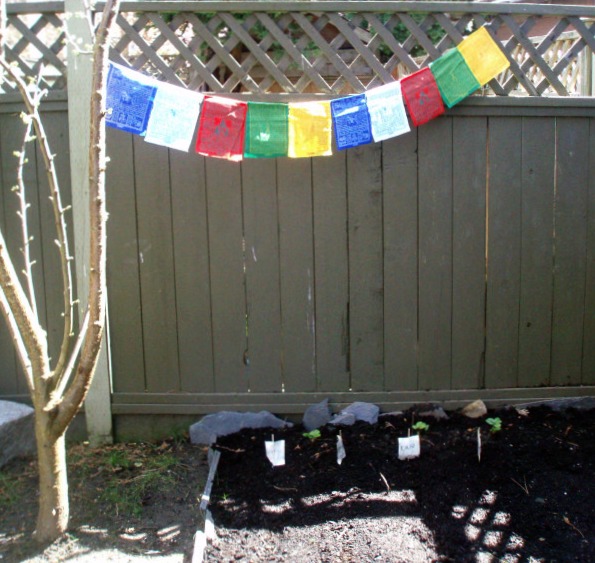
This winter the flags finally blew down and it seemed a good time to put up another set. A conversation arose on twitter and some us—friends who have never met in person—decided to hang them together. Would this maximize the effect of the flags? It would at very least give us one more connection to each other.

Sam hung hers in the morning:
Mine in the afternoon:
Karen's went up the next day:
A few more people noticed and commented, which made me think about some friends who are Tibetan Buddhists. One of them, who prefers to go by her initials, agreed to write about prayer flags for this blog. I apologize for the long introduction but hope you will keep reading, because I love all that she has learned and shared. Thank you, ZYP. I'm honored to have this as my very first guest post.

Prayer Flags
by ZYP

When I agreed to write about Tibetan prayer flags I discovered that flags were a specialized field of interest. Vexillology, I learned, is the scholarly study of flags.     

I know about the symbolism of Buddhist prayer flags, but I was curious about how they came into use historically. As I began researching the history of flags on the internet I became increasingly vexed by the lack of clear historical references about my topic. I wondered if ‘vex’ and ‘vexillology’ share a historical root.   

‘Vex’ is an old word still used to communicate irritation, difficulty and puzzlement. It comes from the Latin root ‘vexare’ - to agitate, or to harry. 

Vexillology has its root in the Latin word ‘velum’ - “a sail.” Vexillum, then, is the ancient Latin for flag and banner. 

People have used flags as a method of communication since ancient history. Flags in ancient times were not like the cloth flags we see hoisted or hung on straight poles in modern times. Flags throughout history could come in various shapes and materials.  They were made of animal skins, wood or metal before cloth became the standard. Flags could be referred to in other terms such as: standards, banners, pennons, pennants, jacks and vexillum. 

The history of flags is dominated by militaristic associations. The earliest referenced example of the modern use and style of flags comes from the Ancient Greeks. They painted symbols on their shields to show tribal loyalty or battle unit.  

The oldest reference I could find about the use of a flag is set in ancient Persia several hundred years BCE. The story is about a blacksmith named Koah who inspired his fellow Persians to overthrow the tyranny of their ruler. Koah reared a banner made of his leather blacksmithing apron to arouse and unite his followers. The banner grew in size as people adorned the apron with embroidery and gems. People people believed the banner held a superstitious power. The fate of the Persian kingdom was believed to be connected to this banner as the kingdom warred with neighboring states. When the banner was finally captured by an opposing army, it was thoroughly destroyed.1

I find it interesting that flags were mainly used for military purposes throughout much of ancient history. That association explains the gradual development of rigid rules and protocols for flags. It is as though flags represent the spirit and power of entire peoples. Desecrating a flag was serious business in ancient history and it is still serious business today. And that brings me back to the idea that vex and vexillum could be connected - at least experientially. Wherever banners of conflict fly, difficulty seems to follow.

In contrast, flags took a different path in the Himalayan Plateau during the course of history. To be sure, flags were used for military purposes in ancient Tibet, but they were also used for peaceful gatherings of the nomadic tribes. Eventually followers of Tibet’s oldest spiritual tradition, Bon, used flags in rituals for luck, happiness, healing, and protection. Tibetan Buddhism adopted the ritual of prayer flags and infused it with its own symbolism. But the aspiration remained a wish for good fortune, health, wealth, long-life, the power of accomplishment, and all good things. 

Buddhism entered Tibet from India around 200 CE. It spread slowly in the first century but then began to flourish. As Indian Buddhism was adopted into Tibetan culture, the traditional Bon religion and Buddhism influenced each other. Today Bon and Tibetan Buddhism share some basic symbols and rituals, and the differences between others can be subtle. According to both traditions prayer flags are imbued with the power of the symbols printed on them. Both traditions consider the wind as a magnificent horse upon which blessings ride. Some people call prayer flags Lung-ta, or Windhorse. Lung refers to the body’s subtle inner energy, or wind. Ta means horse. Windhorse. Traditional language refers to prayer flags as Dar-chen or Dar-ding. Dar means flag. Dar-ding are long strings of flags flown horizontally between buildings or trees. Dar-chen are narrow flags flown from poles.

Most of the traditional symbols and prayers still used today were designed by great Buddhist and Bon teachers back through history. The flags were hand painted at first, but the designs were eventually carved into wood blocks for printing. Today, the traditional wood block designs have been converted to allow silk screen printing. This is the most common method of making prayer flags in the West. Unlike military, state or national flags, prayer flags are left to flutter in the open until they fray and fade. They can be hung anywhere a breeze might catch the cloth.

Traditional flags are strung in a series of 5 colors: yellow, green, red, white and blue. It does not matter if yellow is first or last as long as they are in this sequence. The colors are symbolic of the 5 elements that are the most subtle expression of physical existence and activity according to Buddhist philosophy. Each element has unique qualities that interact with each other element. Yellow symbolizes the earth element, green symbolizes the water element, red symbolizes the fire element, white symbolizes the air element, and blue symbolizes the space element.

The elements are sequentially more refined or more substantial depending on the direction they move. The sequence of the flags and elements can symbolize bringing something good into existence if the movement is from space to earth. In the other direction, the sequence can symbolize that suffering dissolves into the space element. The space element is another meaning of Lung. Within the space element all things are pure.

Prayer flags also contain images of mystical animals and other beings that convey meaning and activity. The symbol of the mystical Windhorse is on one of the most popular images found on prayer flags. Its symbolism conveys the idea that the desired result will be achieved quickly.

Some flags contain Tibetan prayers or short teachings on them. Some flags have sequences of syllables that have great spiritual meaning all wrapped up in symbolic language. These are called awareness spells, or mantra. I think of mantra as being like a coin purse you can keep in your pocket, but when you open it, you know the wealth of the entire universe is in there.

The colors alone give prayer flags meaning. The elements are further enriched with other symbols and words to give them specific powers and focus. Finally, the ritual of raising the flag involves being in the right frame of mind. From this perspective, raising the Windhorse becomes internal as one aligns one’s energy and aspiration and extends that wish as a prayer to help all beings. The flag gathers all of this energy and it is sent out freely on the wind to benefit everyone and everything everywhere.


For more information try this linkAnd this one.

1Source: G.H.Preble. The Symbols, Standards, Flags, and Banners of Ancient and Modern Nations.  Referenced by: Pier Paolo Lugli, 8 June 1999 here.
Monday, June 28, 2010

tagged

I haven't been sitting inside much lately. The long-neglected yard has been beckoning, and then you know how it is: one project leads to another, and another, and another.


This morning, though, is already pushing toward 100 degrees so pulling the shades down and trying not to move seems like a good idea. Plus, my twitter buddy Kyong tagged me with this little questionnaire. I am so new at blogging that this feels like having a neighbor come by with a casserole. 


Thank you, Kyong! Here are my answers:


1. What's your staple meal (i.e., what meal do you cook most often when you can't be bothered to be adventurous)?
We eat a lot more pasta than I'd like to admit--typically pasta, olive oil and grated parmesan cheese, with steamed broccoli on the side. It's fast and mindless, and we all like it.


2. What do you want to be when you grow up?
My unschooling self is fine with the idea of continuous development, and my strong Myers-Briggs "P" aspect balks at having to be pinned down. But truth be told, I feel pretty grown up already and happy with where I am: home-centered with the kids.


3. What book are you reading at the moment (if any)?
I'm reading Shakespeare by Another Name by Mark Anderson. It explores the premise that the works attributed to Shakespeare were in fact written by Edward deVere, the Earl of Oxford during Elizabeth I's reign. This is an old idea, first proposed by Thomas J. Looney in 1920, and Anderson makes a thorough and compelling case. It's a great read.


4. How do you relax?
When I'm at home, I'm constantly looking at things that need to be done. I relax best going out somewhere--a friend's house, a restaurant, the park, a beach.


5. What color are the interior walls of your home?
We have had many colors in here, but as of last summer, the walls are mostly various shades of green.


6. What is your guiltiest pleasure?
I was going to say that I don't think 'guilty' and 'pleasure' belong side by side, but in fact, I always feel a little guilty enjoying myself without at least some of the family around. I also feel guilty if I play Kwazi's Quest for too long!


7. What time is bedtime and getting up time?
That would be midnight and 7 am, almost every day of the week.


8. How long do you spend reading blogs (per day or per week)?
I go through periods of heavy blog reading and others, such as lately, where I read almost nothing at all. If a blog has an email subscription option, I will always take that over having to subscribe via a reader since I do check email at least daily.


Now it seems I am supposed to tag others. I wanted to tag the 12 kind followers of this blog, but I haven't been able to figure out how to get to them. Is it because I'm using Draft? I can't seem to click through to anyone.


So if you are reading this blog and have any inclination at all, I would love to see your answers to these questions--or to any others that may appeal to you (Myers-Briggs P). Please let me know if you do.


And stay cool.


Saturday, April 10, 2010

old kodak

My twitter friend Maya and I recently had a brief exchange about old cameras, during which she mentioned a Kodak 1A she found recently--for $2! You can read about her camera and look at her beautiful photos of it here.

This reminded me of my very similar Kodak 3A, which my sisters gave me for Christmas in the 1970s. Not as beautiful or complete as Maya's 1A, I have nonetheless carried it around through countless moves because it is old and amazing.


See the little raised bump in the center of this next photo? The leather has worn off a little and shows an orange-y color underneath. (And gee, could I have maybe wiped the dust off before taking the picture? Sorry about that.)


When you press on that little button, the camera opens up and the bellows lens can be extended.


I love the Gothic lettering of the name Kodak. That metal tab also props the camera up like a little built-in tabletop tripod.


Until I read Maya's post, I didn't know about the autographic feature of this camera--mine no longer has its stylus. I also never seriously entertained the idea of converting it for use with 120 film. I'm an impatient sort and remember too well the frustration of waiting to develop and print film.

But do I appreciate that all this can be done? Absolutely. Even more do I love the ease with which this type of information now flows around. In the mid '70s, this camera was simply a curio, and I vividly recall combing through the big green periodical files at the library in a fruitless search for any information at all about it.

Now I can type its name and instantly learn when it was in production, look at images of different versions, bid on one online, even download an original manual. Or simply open my twitter feed and have a conversation about it. How amazing is that?

Friday, April 2, 2010

twitter & tie-dyed eggs

The power of Twitter: A couple weeks ago, I retweeted a link from @DawnSandomeno, a woman I've never met or even, as far as I remember, had any exchange with. The link led to this page

A local friend immediately got excited and began scavenging for silk ties. A few days later, she tweeted out to her crowd an invitation to dinner and egg dyeing.

She received tweets back with offers of salad, dessert, extra eggs.

Tonight we all gathered.

Here are the ties we started with:


We snipped


wrapped


boiled


and took them out to cool


There was so much going on that I didn't even think to take pictures of the kids and teens playing games in the garage or of all the delicious homemade food. Music was playing; conversations were going in every corner of the room. And no party can go wrong with an adorable baby and a sweet black lab:


One picture I really wish I'd had was of us unwrapping the first egg, which came out completely white. We were stunned and decided we must not have added enough vinegar. To the next pot, we were more generous and threw in an extra glug or two.

We got some gorgeous results


but the shells seemed curiously fragile. We were puzzled until someone had an aha! moment. Can you figure it out?

Fun projects are passed across the country and stimulate friends to share an evening together. Twitter: frivolous and narcissistic? Not in my book.

I prefer to think of it as a vibrant community gathering.


Related Posts Plugin for WordPress, Blogger...